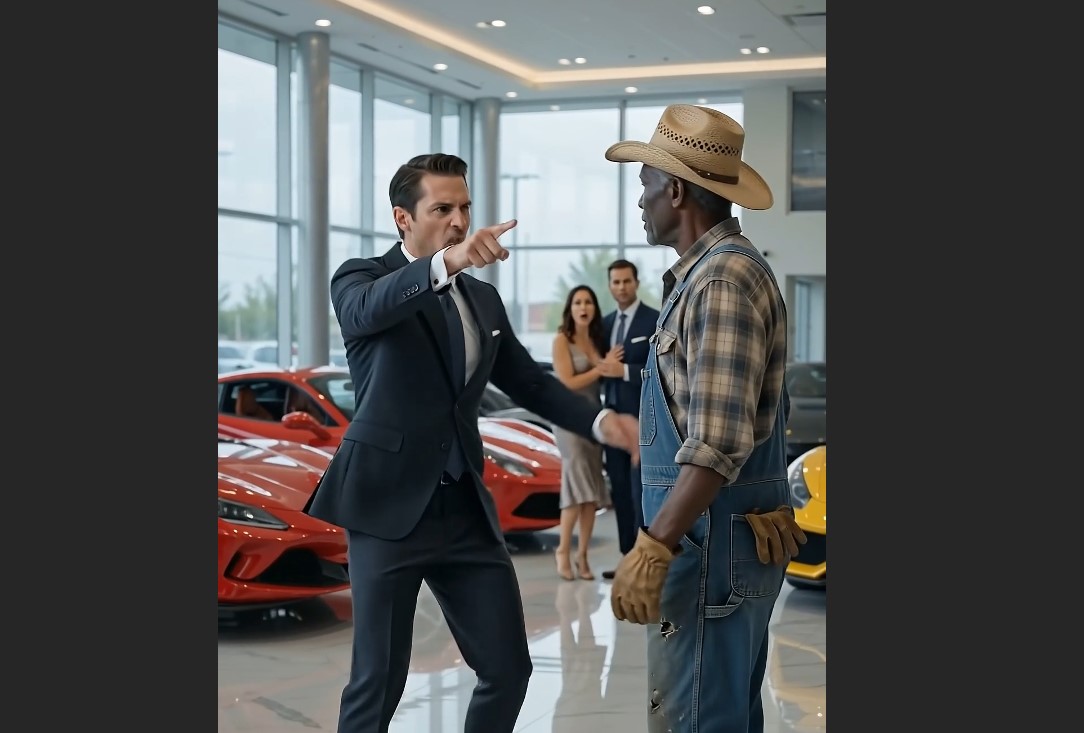
The atmosphere inside the luxury car dealership was polished, quiet, and carefully controlled. Expensive vehicles stood beneath bright showroom lights, their flawless paint reflecting across the marble floor. Customers moved slowly between the displays while sales employees in tailored suits offered detailed explanations about engines, interiors, and custom options.
Then the glass entrance doors opened, and an older farmer stepped inside.
He was around 65 years old and wore faded denim overalls, a dusty plaid shirt, worn work boots, and an old straw hat. His clothes showed the marks of a long day outdoors. However, his posture was steady, and he looked around the showroom with calm interest.
A young salesman noticed him immediately.
Instead of welcoming the visitor, the salesman hurried across the room and stopped directly in front of him. His sudden movement attracted the attention of several customers.
“Stop right there,” the salesman said loudly.
The farmer paused.
The salesman looked down at the man’s work boots and then glanced toward the spotless marble floor.
“Do you realize where you are?” he asked. “This is a luxury dealership. Those boots are covered in dirt.”
The farmer remained composed.
“I’m here to buy a car,” he replied.
The salesman laughed, apparently believing the statement was a joke. A few customers exchanged uncomfortable looks. One employee behind a nearby desk stopped typing and quietly watched the interaction.
“You want to buy one of these cars?” the salesman asked. “Perhaps you should try the used-car lot across the street.”
The farmer did not respond angrily. He simply looked toward the row of luxury vehicles and then back at the salesman.
“May I speak with the owner?” he asked.
The request seemed to irritate the salesman even more.
“The owner is a busy man,” he replied. “He does not have time to meet everyone who walks through the door.”
By then, the showroom had become unusually quiet. Customers were no longer pretending not to notice. Several people looked disappointed by the employee’s behavior, while other members of staff appeared unsure about whether they should intervene.
The salesman finally reached for his radio.
“You should come out here,” he told the owner. “There is someone who insists on speaking with you.”
Moments later, the glass doors of a private office opened. The dealership owner stepped onto the showroom floor wearing a well-fitted suit. The salesman folded his arms, expecting the owner to support him.
But as soon as the owner saw the farmer, his expression changed.
He walked quickly past the salesman and approached the older man with a warm smile.
“Dad,” he said.
The room fell silent.
The owner embraced the farmer while customers and employees watched in surprise. The salesman’s confident expression disappeared. Until that moment, he had believed he understood everything about the man standing before him. In reality, he had not even taken the time to ask his name.
The owner turned toward the employee.
“This is my father,” he explained. “He purchased the land beneath this building and helped finance the company when it was only an idea.”
The salesman lowered his eyes.
The owner continued, speaking firmly but without losing control.
“He worked for decades to build a successful farm. He still wears work clothes because he is proud of the life he created. His appearance never gave you permission to treat him without respect.”
The salesman attempted to apologize.
“Sir, I did not know who he was,” he said quietly.
The farmer finally spoke.
“That is exactly the problem,” he replied. “You should not need to know who someone is before treating that person properly.”
His words carried across the showroom.
The owner informed the salesman that they would discuss the incident privately and that the dealership would be reviewing its customer-service expectations immediately. He also apologized to the customers who had witnessed the uncomfortable exchange.
The farmer then walked toward a luxury sedan displayed near the center of the showroom. He inspected the interior, asked several practical questions, and requested the keys for a test drive.
Before leaving, he looked back at the salesman.
“Never mistake hard work for poverty,” he said. “And never assume that clothing tells you a person’s value.”
The salesman stood silently as the farmer and his son walked toward the vehicle together.
The encounter offered a simple but important reminder. First impressions are often incomplete, and outward appearance rarely reveals a person’s history, achievements, or character. Courtesy should not depend on wealth, status, clothing, or recognition. Every customer—and every person—deserves to be welcomed with basic dignity from the moment they arrive.
This story is a fictional dramatization created to illustrate the importance of respect, professionalism, and avoiding unfair assumptions.