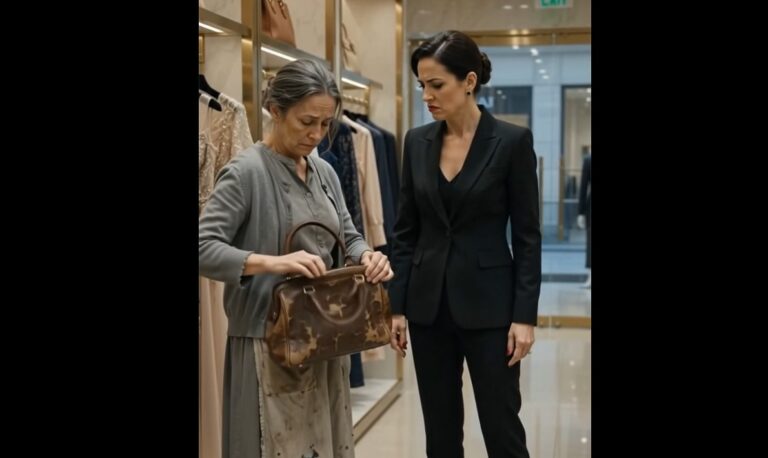
The hotel lobby went completely silent.
Only seconds earlier, the female security guard had been speaking loudly enough for everyone near the entrance to hear. Her hand was still half-raised, frozen in the air, as if her own body had stopped before her mind could catch up.
In front of her stood the elegant woman in the white suit, calm, composed, and holding a gold hotel ownership card between two fingers.
The security guard stared at the card. Her eyes moved from the shining surface to the engraved name, then back to the woman’s face. Her confidence disappeared instantly. Her lips parted, but no words came out.
The woman did not shout. She did not insult her back. She simply held the card steady and said in a controlled voice, “Now read it again.”
The guard swallowed hard. Her voice came out weak.
“I… I didn’t know.”
The woman lowered the card slowly.
“That is exactly the problem,” she replied. “You decided who I was before you knew anything.”
Several guests exchanged uncomfortable looks. The hotel manager rushed forward from the reception area, his face pale with panic. Behind him, two staff members stood frozen near the luggage cart, unsure whether to move or stay still.
“Ms. Carter,” the manager said quickly, “I am deeply sorry. We were expecting you this morning, but I didn’t realize you had already arrived.”
The security guard’s expression changed from shock to fear.
“Ms. Carter?” she whispered.
The manager turned toward her and spoke carefully, but firmly.
“This is Evelyn Carter. She is the principal owner of this hotel group.”
A quiet wave of surprise moved through the lobby. The guests who had been watching with curiosity now looked embarrassed. The guard took a step back, her hand dropping fully to her side.
“Ma’am,” the guard said, her voice trembling, “I apologize. I thought—”
“You thought I did not belong here,” Evelyn interrupted.
The guard looked down. She had no answer.
Evelyn turned slightly and looked around the lobby. Her eyes passed over the chandeliers, the polished marble floor, the gold pillars, and the nervous faces of the staff.
“This hotel spends millions to look luxurious,” she said. “But luxury is not gold on the walls. It is how people are treated at the door.”
The manager lowered his head.
“You’re right,” he said. “This should never have happened.”
Evelyn placed the gold card back into her handbag. Then she looked directly at the guard.
“I am not interested in humiliating you the way you tried to humiliate me,” she said. “But I am interested in accountability.”
The guard’s eyes filled with worry.
“Am I being fired?” she asked quietly.
Evelyn paused for a moment.
“That depends on what you learn from today.”
The manager looked surprised. He had expected a harsher decision, especially after such a public mistake.
Evelyn continued, “You will be removed from front entrance duty immediately. You will complete guest respect training, hospitality ethics training, and bias awareness training. After that, the management team will decide whether you are fit to represent this hotel again.”
The guard nodded quickly.
“Yes, ma’am. I understand.”
“No,” Evelyn said softly. “I don’t think you understand yet. But I hope you will.”
The words landed harder than shouting would have.
Then Evelyn turned to the manager.
“Call a full staff meeting in thirty minutes.”
“Of course,” he replied.
“And invite everyone. Security, reception, housekeeping, valet, restaurant staff—everyone.”
The manager nodded again.
“Yes, Ms. Carter.”
Thirty minutes later, the entire hotel staff gathered in a private conference room. The security guard stood near the back, still shaken. Evelyn stood at the front, not with anger, but with authority.
“Today,” she began, “I was stopped at the door of my own hotel. Not because I caused trouble. Not because I broke a rule. But because someone looked at me and decided I did not belong.”
No one spoke.
“This hotel will not operate that way,” Evelyn continued. “Every guest who walks through our doors must be treated with dignity before status, respect before recognition, and professionalism before assumption.”
The room remained silent, but this time the silence was different. People were listening.
At the end of the meeting, Evelyn announced a new policy. Every employee would receive updated hospitality training. Every complaint about disrespectful treatment would be reviewed seriously. And no staff member, regardless of position, would be allowed to use authority as an excuse for arrogance.
As the staff began to leave, the security guard approached Evelyn slowly.
“Ms. Carter,” she said, “I really am sorry.”
Evelyn looked at her for a long moment.
“Then prove it by changing,” she said.
The guard nodded, this time with real humility.
Later that evening, Evelyn walked through the lobby again. The same gold pillars shined under the chandeliers. The same glass doors opened for guests arriving with luggage, reservations, and expectations.
But something had changed.
The staff stood straighter. The greetings were warmer. The atmosphere felt less like a place built only to impress people with money, and more like a place that understood what true service meant.
Before leaving the lobby, Evelyn glanced once more toward the front entrance.
Then she said quietly to the manager, “A door should never be used to make people feel small.”
He nodded.
And from that day forward, every new employee learned the story of the woman in the white suit, the gold card, and the lesson that changed the hotel.